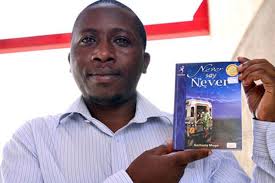
To know Anthony Mugo read this book.
ARTS & CULTURE
POSTED 2/1/2015
I am living proof that there is hope yet in creative writing
 Author Anthony Mugo with two of the books he has written. PHOTO | HUGHOLIN KIMARO |
IN SUMMARY
- With proper support and reward, writers of fiction in Kenya need not despair.
- Creative writing remains a worthy and noble occupation.
Aspiring to be a creative writer in Kenya is a sorry undertaking.
There are wise men who bask in the glory of declaring us a literary desert but do little to water the said desert.
The publisher believes that publishing fiction is dangerous and non-rewarding. If you self-publish then you are half-baked.
If you are lucky enough to publish, the government taxes your book, pushing it down the priority list. Think of finding a pin in a hay sack — in the dark.
Nevertheless, creative writing remains a worthy and noble occupation.
To Sidney Sheldon, a writer plays god in his own world. He can create or kill, endow or deny, punish or reward; he is supreme. Sherlock Holmes, James Bond, and Romeo and Juliet are more noteworthy than millions of mortals who actually lived. Believe me; the pin in the hay sack is worth finding.
I have loved stories all my life. The ogre with four eyes stretched my imagination trying to live his world. The likes of Sidney Sheldon, Alistair McLean, James Hardly Chase and Jeffrey Archer made me wonder whether some well thought lies were not better than the truth. I hoped I would also tell some stories someday.
POOR CHILDHOOD
I was born to a single mother who could hardly support me. I dropped out of school in standard four for lack of school fees. I resumed learning two years later — in an approved school under care and protection.
Now when you find yourself in an approved school, you don’t swim, you sink. You are rotten goods.
I beat the odds, somehow and, after nine years, I joined Moi University hoping to master tenses, gerund, conjunction and the like.
It is foolish, I know, particularly when you are in an economics class, but it was my only hope of learning how to put words together to communicate, educate and entertain.
I wrote my first Swahili play while in Form Two following an advertisement by the National Theatre in tribute to one of their thespians. However, I could not afford to typeset it.
In 1996, I began writing a novel in English. My tenses were still mixed up; I had scored B+ in English but the syntax was still a nightmare.
I wrote on an exercise book using a pencil for easy editing. In 1998, I bought a typewriter but found it too laborious and noisy in the campus hall.
I bought my first computer in 2005 and keyed in the story. My effort culminated in Too Innocent to Die which I presented to one of the local publishers.
After waiting for feedback for a year and a month, I presented it to a second publisher whom I consider more ‘able’. He returned it after four months.
I was demoralised. But I was not going to be deterred. To vent my disappointment, I began working on another story.
MADE ALL THE DIFFERENCE
I have participated in several writing competitions. There was the short story contest organized by Koinoina Foundation in 2000.
Finally, someone won Sh1 million; from writing!
Posted: October 1, 2012 in Events, Issues, News
Tags: Anthony Mugo, Books, Burt Prize for African Literature, Edward Mwangi, Kenya, NBDCK,Ngumi Kibera, writing
Anthony Mugo is probably the richest author in Kenya today. On Friday evening he won Sh1 million in the inaugural Burt Award for African Writing. The Burt Award, administered by the National Book Development Council of Kenya (NBDCK), is the richest literary award in Kenya’s history. His manuscript titled Never say Never has been published by Longhorn Publishers and is out on sale.
The Burt Award is a partnership effort between NBDCK and the Canadian Organisation for Development through Education (CODE), with the support of a Canadian patron Mr. Bill Burt, after whom the prize is named. The award is aimed at encouraging authorship as well as a reading culture among Kenyan children.

Anthony Mugo (center) receives a dummy check for Sh1 Million from Prof Chris Wanjala, that chairman of NBDCK (Right) and Mrs Ruth Odondi, the CEO of NBDCK. At left is Geoff Burt, son of Bill Burt, who graced the occasion.
37-year-old Mugo, who until July was a credit officer with a micro finance company says writing is not new to him. “I have been writing for the last twenty years only that I have never been published,” he explains. In 2009, he participated in another NBDCK organised writing competition, where he won with his manuscript Too Innocent to Die. In 2010 he again participated and emerged victorious with another manuscript, Not a Drop. Mugo, who is married with two children graduated from Moi University with a BA in Economics.
Coming in at second position was Edward Mwangi, who took home Sh500,000. His manuscript, The Delegate, was published by Moran Publishers and is also on sale. The 32-year-old, who has just completed his MBA from Nairobi University, works as a general manager for an engineering company in Nairobi. Mwangi, who is also married with two children says his perseverance has finally paid off. “Every morning before I start working, I write for an hour and another hour after work,” he explains.
In third position was Ngumi Kibera, with his manuscript titled The Devil’s Hill, which is published by Longhorn. Mr Ngumi, who is an established author, won Sh250,000. He is not new to winning; His other book, The Grapevine Stories, a Collection of short stories, won the 1997 edition of the Jomo Kenyatta prize for Literature.
Ngumi is full of praises for the Burt Award saying that it is a timely effort that will take Kenyan writing to the next level. “There is a lot of writing talent in Kenya only that our publishers are not aggressive enough to tap them,” he said. “The fact that there were 400 submissions for this prize is testimony of raw writing talent out there waiting to be discovered.”
Also present during the awards ceremony, held at the Silver Spring Hotel,
Literary Postcard: Author Anthony Mugo mocks evil parents
Oct. 16, 2014, 12:00 am
By KHAINGA O’OKWEMBA
“Anthony Mugo may not be known beyond the circle of writers associated with the National Book Development Council of Kenya, and students in the 25 schools where the council promised to distribute the winning title, yet he is a writer of great potential and promise.”
This is how I described Anthony in one of our Literary Postcard events about two years ago when I first met him at a workshop in Nairobi on the mechanics of writing conducted by distinguished literary scholar and teacher Prof Henry Indangasi and Canadian author Sharon Jennings.
Anthony carried himself with the demeanor of an introvert; shy, melancholic, possessed . But talking to him, I realised that he was a dedicated writer. Discovered by the NBDCK in its nascent days when he won the Budding Writer’s Prize in 2009, Anthony went ahead to win the top prize of the Burt Award for African Literature (2012).
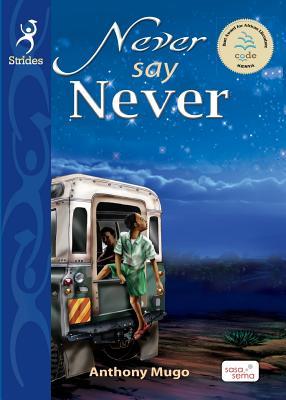
Anthony Mugo’s winning novella, Never Say Never, is a story about a poor boy, set in the approved school — a model institution for correcting and rehabilitating stubborn, rude and bad children. When Anthony was nominated early this year for a second Burt Award, I raised my hand at the media briefing and asked the judges whether it was right to include a writer who had previously won the first prize of the award. Anthony had been nominated for 2014 Burt Award for his novella, Ask the Stars, which in the fullness of time, would make him Sh600, 000 richer!
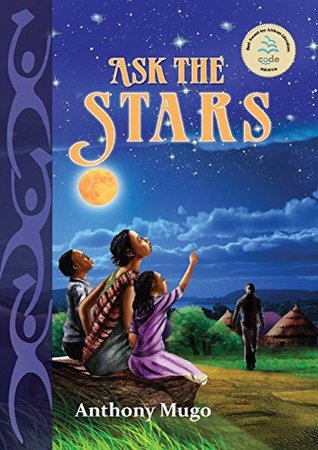
Ask the Stars is a story about siblings who are always squabbling and fighting. Matters come to a head when the children discover that they are step-siblings. The narrator in the story, Titus, learns that the man he and his younger sister call father is not their biological father.
His elder brother Njorua discovers that Titus’ mother whom him and his sister Antonnina call mother, is not their biological mother. Hence, their hitherto sibling-rivalry takes the form of jealousy, protection, and love. Although the man is determined to bring harmony in the family by raising the children without according anyone preferential treatment, the tension among them, especially between the two boys, plays out in the open.
“Now that you have fought, what has changed?” the man asks rhetorically. “You now hate one another more for inflicting much pain on each other, but you are still brothers,” he admonishes the two boys. The boys behave as if they were bulls in the same kraal; they ignore their father’s advice forcing him to assert his authority by punishing them.
The conflict in the story is moulded around “stepbrother-stepsister” suspicion, hatred and loathing, a matter that many in society can identify with. Anthony deals with the problem with great care, almost mockingly – few women, or men, can treat their stepsons and stepdaughters humanely as do the characters in Ask the Stars . He also looks at “stigmatisation.”
Anthony has a unique sense of humour, and he effectively uses suspense to embellish the story and thus pulls the reader along as events unfold.
Few writers can make their reader laugh. His young characters live in the shadow of the old. We see them as they grow and become more tolerant and responsible.
But did they have to wait for tragedy to strike before they could realise their “oneness?” Anthony is no doubt a skillful writer. There is a rapist prowling the neighbourhood. He stalks young girls and attacks them when they are most exposed and vulnerable.
“I sat back to admire my newest creation; a potty man donning a suit made of bank notes enjoying a piggyback on a thin, deathly man in tatters. The caption read: Oh Lord, give me tomorrow that I may know how stupid I am today.”
Meaning, a new dawn does not always change man for better, he may in fact sink even deeper into vanity. The rapist is the son of a politician – the wealthy “potty man.” He is a serial rapist who ends up committing suicide like the character in one of Grace Ogot’s story when he is unmasked. Anthony Mugo only needs to avoid clichés — and you’ll read him, as I do.
PERSISTENCE REWARDED FOR WINNERS OF INAUGURAL BURT AWARD IN KENYA
By Geoff Burt, Literary Prizes Foundation
I recently had the great pleasure of travelling to Kenya with my wife Lauren to take part in the awarding of the inaugural Burt Award for African Literature in Nairobi on September 28. Reading the three winning titles, The Devil’s Hill by Ngumi Kibera (third), The Delegate by Edward Mwangi (second) and Never say Never, by Anthony Mugo (first), it’s clear that at the very least the Burt Award has resulted in some great new books.
The Burt Award always intended to accomplish more than just recognizing and rewarding the talents of the authors. It is not enough that the books are written – they need to be published, distributed to schools and libraries and taught by well-trained teachers. To do this took the ingenuity of CODE in designing the Burt Award program, ensuring the publication and guaranteeing the purchase of the books, as well as major contributions from CODE’s amazing local partners like the National Book Development Council on Kenya (NBDCK), whose Reading Kenya program is work

ing to ensure that teachers are trained to effectively teach and promote reading. After spending time with my host, Ruth Odondi, the CEO of the NBDCK, the members of the award’s jury committee, representatives from the publishing industry, and CODE’s supporters in the Canadian government and the Canadian International Development Agency (CIDA), I came away very aware of and grateful for all of the work that our partners do to make the Burt Award a success.
One of the highlights of the evening was the donation of the winning titles to Windle Trust, an organization that supports education in Kenya’s refugee camps. I am sure the books they receive will be put to good use.
But the awards ceremony really belonged to the authors and their families. The awards were very richly deserved for a group of authors who have been working towards this for years. Each of the authors told me about the many unpublished manuscripts that they had written before. Even award-winning stories have gone unpublished. The winning author Anthony Mugo has been writing manuscripts for over 20 years. He wakes up at 4am to write and writes another two hours every night before going to sleep. The second runner up, Ngumi Kibera, told me that winning the award convinced him to try focusing full-time on being a writer. I would not be surprised if there is much more to come from each of the winners!
The Star (Nairobi)
Kenya: Burt Award-winning authors launch books
Feb. 14, 2015, 7:00 am
By ENOS TECHE
 Winners of the 2014 Burt Award authors Antony Mugo and Elizabeth Kabui holding a dummy copy of their books.
Two books, "Ask the Stars" by Antony Mugo and "Was Nyakeeru my Father"by Elizabeth Kibui were launched at a colourful dinner in Nairobi's Intercontinental Hotel on Tuesday evening.
The two books, published by Longhorn Publishers, won big at the Burt Awards last year with Kibui winning and Mugo as first runners up. The Burt Awards recognise authors with books targeted at young adults.
Present at the colourful launch were Masinde Muliro deputy vice chancellor Dr Egara Kabaji, Longhorn publisher head of publishing Beatrice Nugi and Professor Henry Ndagasi.

First-time author wins inaugural Burt Award for African Writing
Anthony Mugo, author of Never Say Never published by Longhorn Publishers. He won the inaugural Ksh1 million ($11,900) Burt Award for African Writing. Nation Media Group
By Joseph Ngunjiri
Posted Friday, October 5 2012 at 13:28
IN SUMMARY
- His story-turned-book Never Say Never, which has been published by Longhorn Publishers, emerged the winner ahead of Edward Mwangi’s The Delegate (published by Moran Publishers) and Ngumi Kibera’s The Devil’s Hill (published by Longhorn).
First-time author Anthony Mugo is the winner of the inaugural Ksh1 million ($11,900) Burt Award for African Writing.
The Burt Award, administered by the National Book Development Council of Kenya (NBDCK), is the richest literary award in Kenya’s history.
His story-turned-book Never Say Never, which has been published by Longhorn Publishers, emerged the winner ahead of Edward Mwangi’s The Delegate (published by Moran Publishers) and Ngumi Kibera’s The Devil’s Hill (published by Longhorn).
The first and second runners-up received Ksh500,000 ($5,950) and Ksh250,000 ($2,975) respectively.
The Burt Award, to be awarded annually, is a partnership between NBDCK and the Canadian Organisation for Development through Education with the support of Canadian patron Bill Burt, after whom the prize is named.
The award is aimed at encouraging authorship as well as a reading culture among Kenyan children.
NBDCK will purchase 3,000 copies of each of the winning titles and distribute them free of charge to schools that they work with. The publishers are expected to sell at least 2,000 copies of the books.
After the Burt Prize for African Writing, the Jomo Kenyatta Prize for Literature comes in at a distant second, in terms of prize money, at Ksh150,000 ($1,785) for the winners, in both the English and Kiswahili categories for adults.
In the youth and children’s categories, winners get Ksh75,000 ($893) each. The Jomo Kenyatta Prize for Literature is sponsored by Textbook Centre.
The Wahome Mutahi Prize, in its sixth edition, lags behind when it comes to prize money.
Winners in the English and Kiswahili categories get Ksh50,000 ($593). The prize, in honour of the late humourist Wahome Mutahi, is wholly funded by the Kenya Publishers Association (KPA).
Both the Jomo Kenyatta Prize for Literature and the Wahome Mutahi Prize are administered by KPA
t
t
http://www.www.theeastafrican.co.ke/image/view/-/1525640/medRes/406963/-/vxpcxr/-/anthony.jpg
Skip to the navigationchannel.links.navigation.skip.label.Skip to the content.Africa Review | Daily Nation | Business Daily | NTV | Daily Monitor | The Citizen | Mwananchi | Swahili Hub
- News
- Business
- Opinion and Editorial
- Science and Health
- Magazine
- Rwanda Today
- Infographics
- EA Universities Guide


MAGAZINE
First-time author wins inaugural Burt Award for African Writing


Anthony Mugo, author of Never Say Never published by Longhorn Publishers. He won the inaugural Ksh1 million ($11,900) Burt Award for African Writing. Nation Media Group
By Joseph Ngunjiri
Posted Friday, October 5 2012 at 13:28
IN SUMMARY
- His story-turned-book Never Say Never, which has been published by Longhorn Publishers, emerged the winner ahead of Edward Mwangi’s The Delegate (published by Moran Publishers) and Ngumi Kibera’s The Devil’s Hill (published by Longhorn).
First-time author Anthony Mugo is the winner of the inaugural Ksh1 million ($11,900) Burt Award for African Writing.
The Burt Award, administered by the National Book Development Council of Kenya (NBDCK), is the richest literary award in Kenya’s history.
His story-turned-book Never Say Never, which has been published by Longhorn Publishers, emerged the winner ahead of Edward Mwangi’s The Delegate (published by Moran Publishers) and Ngumi Kibera’s The Devil’s Hill (published by Longhorn).
The first and second runners-up received Ksh500,000 ($5,950) and Ksh250,000 ($2,975) respectively.
The Burt Award, to be awarded annually, is a partnership between NBDCK and the Canadian Organisation for Development through Education with the support of Canadian patron Bill Burt, after whom the prize is named.
The award is aimed at encouraging authorship as well as a reading culture among Kenyan children.
NBDCK will purchase 3,000 copies of each of the winning titles and distribute them free of charge to schools that they work with. The publishers are expected to sell at least 2,000 copies of the books.
After the Burt Prize for African Writing, the Jomo Kenyatta Prize for Literature comes in at a distant second, in terms of prize money, at Ksh150,000 ($1,785) for the winners, in both the English and Kiswahili categories for adults.
In the youth and children’s categories, winners get Ksh75,000 ($893) each. The Jomo Kenyatta Prize for Literature is sponsored by Textbook Centre.
The Wahome Mutahi Prize, in its sixth edition, lags behind when it comes to prize money.
Winners in the English and Kiswahili categories get Ksh50,000 ($593). The prize, in honour of the late humourist Wahome Mutahi, is wholly funded by the Kenya Publishers Association (KPA).
Both the Jomo Kenyatta Prize for Literature and the Wahome Mutahi Prize are administered by KPA.